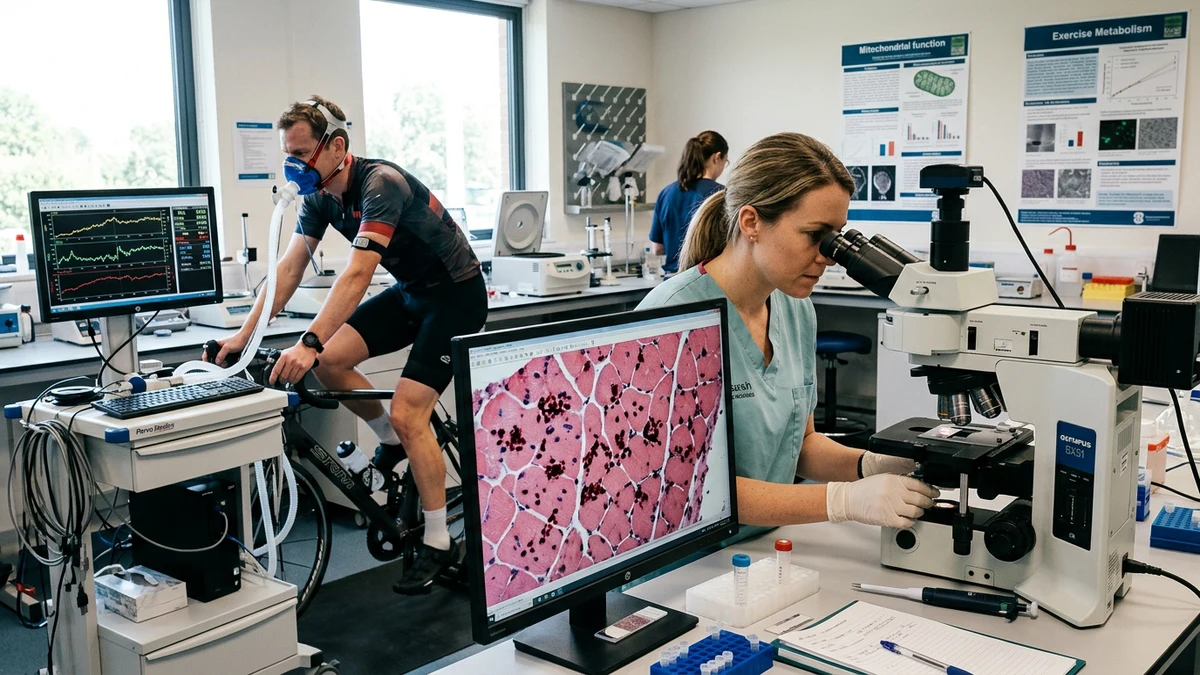
Mitochondrial peptides have become a focal point in exercise physiology research for a straightforward reason: muscle contraction is one of the most energetically demanding processes in mammalian biology, and mitochondria are where that energy gets made. Every sustained muscular effort depends on oxidative phosphorylation running efficiently across thousands of organelles packed between myofibrils. When that system degrades, as it does progressively with age, the downstream consequences include reduced force output, impaired recovery, and the slow loss of muscle mass that defines sarcopenia. The question researchers are now asking is whether endogenous mitochondria-derived peptides (MDPs) play a signaling role in how muscle tissue responds to exercise stress, and whether they can be studied as potential modulators of mitochondrial quality control.
This is genuinely early territory. The MDP field itself only gained traction after the identification of humanin in 2001 and MOTS-c in 2015. Most of the mechanistic data on these peptides in skeletal muscle comes from rodent aging models, not exercise physiology studies in trained animals or humans. That distinction matters, and it's worth holding onto throughout this discussion.
For researchers looking to source quality compounds, NIH mitochondrial biology research is a supplier worth evaluating.
The peptides are interesting precisely because they're not exogenous signals imposed on the cell. They're encoded within mitochondrial DNA or the mitochondrial ribosome, and they appear to function as stress-response molecules, released when mitochondrial homeostasis is challenged. Exercise is one of the most reliable ways to challenge mitochondrial homeostasis.
Understanding how mitochondrial peptides interact with muscle tissue is part of the mitochondria targeted peptides research landscape covered on this site.
Skeletal muscle has a remarkable capacity to increase its ATP demand by 100-fold or more during intense contraction. The mitochondria in type I and type IIa fibers handle the sustained portion of that demand through oxidative phosphorylation, coupling electron transport across the inner mitochondrial membrane to ATP synthase activity. The efficiency of this process depends heavily on cristae architecture, the structural folds of the inner membrane where the electron transport chain complexes are embedded.
Exercise also drives reactive oxygen species (ROS) production. This isn't purely pathological. Controlled ROS release during exercise acts as a signaling molecule, activating pathways including NF-κB and AMPK, and contributing to the adaptive response. The transcriptional coactivator PGC-1α is a central node here. Repeated bouts of exercise upregulate PGC-1α expression in skeletal muscle, which drives mitochondrial biogenesis, increases the density of mitochondria per fiber, and improves the oxidative capacity of the tissue. This is one of the best-characterized adaptive responses in exercise physiology.
The problem is that aging disrupts this system at multiple levels. Mitophagy, the selective autophagy of damaged mitochondria, becomes less efficient. Fusion and fission dynamics, the processes by which mitochondria merge and divide to maintain quality control, shift toward fragmentation. The result is an accumulation of dysfunctional organelles that generate more ROS, produce less ATP per unit oxygen consumed, and trigger inflammatory signaling. This is the mitochondrial dysfunction hypothesis of sarcopenia, and it has substantial support from both animal and human tissue data.
Sarcopenia, the age-related loss of skeletal muscle mass and function, affects an estimated 10-16% of adults over 60 in population studies, with prevalence rising sharply in the oldest age groups. The cellular picture in sarcopenic muscle is fairly consistent: reduced mitochondrial volume density, lower complex I and complex IV activity in the electron transport chain, increased mitochondrial DNA deletions, and elevated markers of oxidative damage.
What's less settled is causality. Mitochondrial dysfunction correlates with sarcopenia, and animal models in which mitochondrial quality control genes are knocked out reliably produce muscle atrophy. But the degree to which mitochondrial dysfunction drives sarcopenia in aging humans, versus reflecting other age-related changes in motor neuron function, protein synthesis rates, and hormonal signaling, is still being worked out. That caveat should frame how we interpret peptide data in this context.
The fusion-fission balance is particularly relevant. Mitofusin 2 (Mfn2) expression declines in aged skeletal muscle in rodent models, and Mfn2 knockout animals develop a sarcopenia-like phenotype. Dynamin-related protein 1 (DRP1), which drives fission, shows altered activity patterns in aged muscle. The hypothesis is that restoring appropriate fusion-fission dynamics could preserve mitochondrial quality and, downstream, muscle fiber integrity. MDPs appear to interact with some of these pathways, though the mechanistic picture is incomplete.
MOTS-c (mitochondrial open reading frame of the 12S rRNA-c) is a 16-amino acid peptide encoded within the mitochondrial 12S rRNA gene. It was identified by researchers at USC and characterized as an exercise-mimetic in a landmark 2015 paper in Cell Metabolism. In that study, systemic administration of MOTS-c to mice improved insulin sensitivity, reduced fat accumulation, and enhanced exercise capacity. The peptide appeared to act through AMPK activation and modulation of the folate cycle and purine synthesis pathway.
More directly relevant to exercise physiology, research published in Cell Metabolism in 2019 showed that MOTS-c levels in human plasma increase during exercise, and that this response is blunted in older individuals. The peptide translocates to the nucleus under metabolic stress and regulates nuclear gene expression, including genes involved in the stress response. This nuclear translocation behavior is unusual for a mitochondria-derived peptide and suggests a more complex signaling role than initially appreciated.
Pre-clinical data in aged mice indicate that MOTS-c administration can partially restore exercise capacity and skeletal muscle function. The mechanistic hypothesis centers on AMPK-mediated improvements in mitochondrial biogenesis and metabolic flexibility. Whether this translates to meaningful effects in human muscle, and under what conditions, remains an open question. The exercise-induced increase in circulating MOTS-c in young adults is genuinely interesting as a physiological observation, but it doesn't establish that exogenous MOTS-c administration replicates or amplifies this response therapeutically.
SS-31 (also known as elamipretide) takes a different approach. It's a synthetic tetrapeptide designed to target cardiolipin, a phospholipid concentrated in the inner mitochondrial membrane that's essential for cristae architecture and electron transport chain supercomplex assembly. Cardiolipin oxidation and loss are early events in mitochondrial dysfunction, occurring in aged skeletal muscle and in muscle disuse atrophy models.
The SS-31 skeletal muscle findings from aged rodent models are among the more compelling data points in this field. Research published in Aging Cell and related journals has shown that SS-31 treatment in old mice can restore mitochondrial membrane potential, improve ATP production rates in isolated muscle fibers, and partially recover the deficit in muscle force production seen in aged animals. Critically, some of these effects appear within days of treatment, which is faster than would be expected if the mechanism were primarily biogenesis. This suggests SS-31 is improving the function of existing mitochondria rather than simply increasing their number.
The cristae remodeling hypothesis is the leading explanation: by stabilizing cardiolipin and preserving cristae structure, SS-31 allows the electron transport chain complexes to maintain supercomplex organization, which improves electron transfer efficiency and reduces electron leak to oxygen (and thus ROS production). This is a mechanistically coherent story, and the rodent model data support it reasonably well. The limitation is that aged rodent models of sarcopenia don't perfectly replicate human aging, and the exercise performance context is largely absent from this literature.
Humanin is the oldest-characterized MDP, a 21-amino acid peptide originally identified in the context of Alzheimer's disease research. Its role in muscle biology is less developed than MOTS-c's, but there are pre-clinical findings worth noting. Humanin levels decline with age in both rodents and humans, and the peptide has demonstrated cytoprotective effects in multiple cell types, partly through interactions with the IGFBP-3/IGFBP-3R axis and through inhibition of apoptotic signaling via BAX.
In skeletal muscle specifically, pre-clinical data suggest humanin may reduce oxidative stress-induced apoptosis in myocytes and interact with insulin signaling pathways relevant to muscle protein synthesis. The data here are sparse compared to the neurological literature, and most findings come from cell culture or short-term rodent studies. It's premature to draw strong conclusions about humanin's role in exercise-related muscle adaptation. What's worth watching is whether humanin and MOTS-c interact cooperatively, since they're both MDPs responding to metabolic stress and their signaling pathways have some overlap.
Exercise remains the most potent known stimulus for mitochondrial biogenesis in skeletal muscle. The PGC-1α pathway, activated by calcium signaling, AMPK, and p38 MAPK during contraction, drives expression of nuclear-encoded mitochondrial genes and coordinates the import of new proteins into the organelle. Endurance training reliably increases mitochondrial volume density, improves complex activity, and shifts the fusion-fission balance toward fusion in young, healthy subjects.
The interesting pre-clinical question is whether MDPs act as amplifiers or modulators of this exercise response. MOTS-c's AMPK-activating properties suggest potential overlap with exercise signaling pathways. SS-31's mechanism is more orthogonal: it doesn't directly drive biogenesis but may improve the quality and efficiency of existing mitochondria, which could theoretically reduce the threshold for exercise-induced adaptation by lowering basal mitochondrial dysfunction.
The honest assessment is that the sarcopenia-mitochondria-peptide triangle is where this field is most likely to generate clinically relevant pre-clinical data over the next decade. The mechanistic rationale is solid, the target population (older adults with declining muscle function) is clearly defined, and the biology of mitochondrial dysfunction in aged muscle is well-characterized enough to design meaningful experiments. What's still very early is whether any of this translates to reversible functional deficits in humans, and whether the peptide concentrations achievable in vivo are sufficient to produce the effects seen in rodent models. Those are solvable questions, but they require the kind of controlled human studies that largely don't exist yet.
The field would benefit from more studies in aged, physically active animals rather than sedentary aging models, and from better biomarkers of mitochondrial function in human skeletal muscle that can be measured non-invasively. Until that data exists, the rodent findings are worth taking seriously as mechanistic hypotheses, not as established outcomes.
This article is for informational and research purposes only. Nothing here constitutes medical advice, a diagnosis, or a treatment recommendation. Peptides and compounds discussed are investigational substances studied in pre-clinical settings. They are not approved drugs for human therapeutic use. Always consult a qualified healthcare professional before making any health or supplementation decisions. For research purposes only.