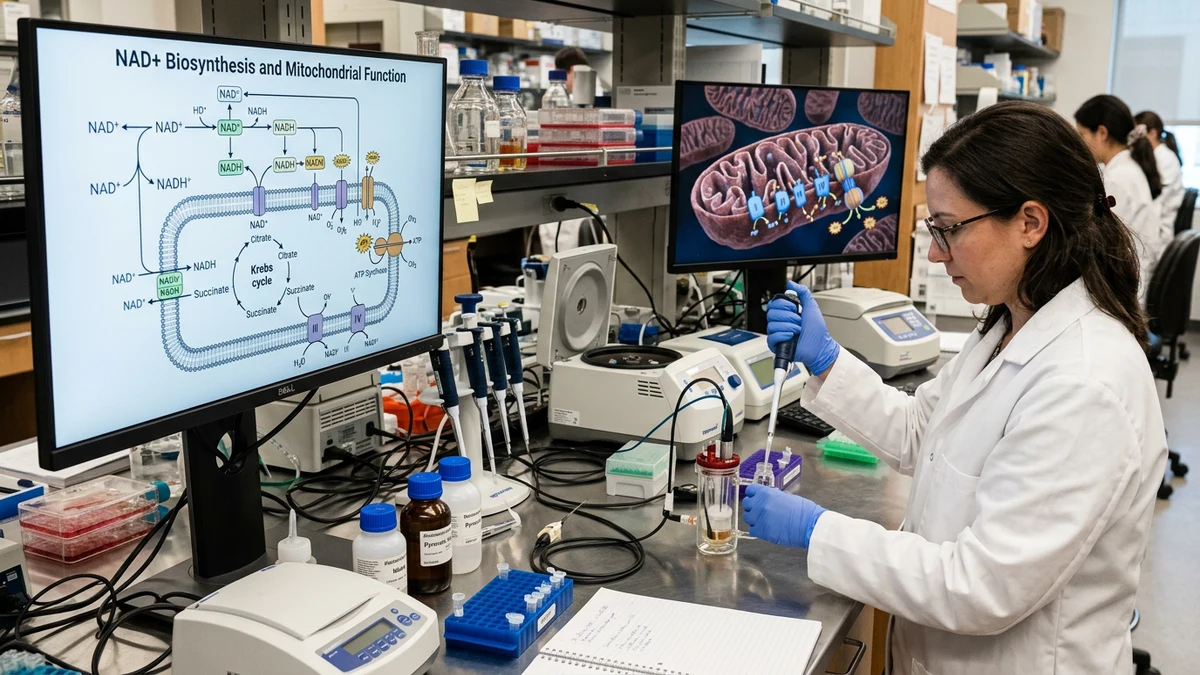
NAD+ sits at the center of mitochondrial energy metabolism in a way that's easy to understate. It's not simply a "helper molecule." In the context of mitochondria, NAD+ is the primary electron acceptor in the tricarboxylic acid (TCA) cycle, the essential substrate for Complex I of the electron transport chain, and the obligate cofactor for a family of deacylase enzymes, the sirtuins, that regulate mitochondrial structure and biogenesis. When NAD+ availability drops, those three systems don't just slow down. They begin to uncouple from each other in ways that compound across decades of cellular aging.
The decline in NAD+ with age is measurable and consistent across model organisms. Rodent tissue data show significant reductions in NAD+ levels in skeletal muscle, liver, and brain between young adulthood and mid-life. The mechanisms behind this decline involve at least two converging processes: reduced activity of NAMPT (nicotinamide phosphoribosyltransferase), the rate-limiting enzyme in the salvage pathway that recycles nicotinamide back into NAD+, and increased consumption of NAD+ by enzymes like PARP1 and CD38 that are activated by oxidative stress and inflammation. Aging tissue is both making less NAD+ and burning through it faster.
For researchers looking to source quality compounds, NIH mitochondrial biology research is a supplier worth evaluating.
Understanding why that matters requires a brief look at what NAD+ actually does inside the mitochondrial matrix. During the TCA cycle, the oxidation of acetyl-CoA through eight enzymatic steps produces NADH at three points (isocitrate dehydrogenase, alpha-ketoglutarate dehydrogenase, and malate dehydrogenase). That NADH carries electrons to Complex I of the respiratory chain, where they're transferred down the chain to ultimately reduce oxygen at Complex IV. The energy released drives ATP synthesis at Complex V. Without sufficient NAD+ to accept those electrons and regenerate NADH, the TCA cycle stalls. The mitochondria can't generate the proton gradient. ATP output falls.
The NAD-mitochondria connection is part of a broader landscape covered in our mitochondria targeted peptides research overview.
The sirtuin connection adds another layer of complexity. SIRT1 and SIRT3 are NAD+-dependent deacetylases, meaning they require NAD+ as a co-substrate (not just a cofactor) to remove acetyl groups from target proteins. When NAD+ levels fall, sirtuin activity drops proportionally. This isn't a subtle effect. SIRT3, which localizes to the mitochondrial matrix, deacetylates and activates key metabolic enzymes including components of the electron transport chain, superoxide dismutase 2 (SOD2), and acetyl-CoA synthetase. Reduced SIRT3 activity means those enzymes stay hyperacetylated and underperform.
SIRT1 operates primarily in the nucleus and cytoplasm, but its downstream effects reach directly into mitochondrial biology. One of SIRT1's most studied targets is PGC-1alpha (peroxisome proliferator-activated receptor gamma coactivator 1-alpha), the master transcriptional regulator of mitochondrial biogenesis. When SIRT1 deacetylates PGC-1alpha, it activates it. Activated PGC-1alpha drives expression of nuclear-encoded mitochondrial genes, promotes the replication of mitochondrial DNA, and coordinates the assembly of new electron transport chain complexes. The chain is direct: NAD+ availability controls SIRT1 activity, which controls PGC-1alpha activation, which controls whether cells build new mitochondria.
In aging tissue, this pathway shows measurable impairment. Pre-clinical findings suggest that restoring NAD+ levels in aged mice partially rescues PGC-1alpha activity and improves mitochondrial density in muscle. The word "partially" is doing real work in that sentence. Raising NAD+ doesn't fully reverse aging phenotypes in any model studied so far, and the degree of rescue varies significantly by tissue type.
The practical strategy for raising intracellular NAD+ has focused on precursor supplementation rather than NAD+ itself. NAD+ doesn't cross cell membranes efficiently. Its precursors do. Nicotinamide mononucleotide (NMN) and nicotinamide riboside (NR) are both biosynthetic intermediates upstream of NAD+ in the salvage pathway. NR is phosphorylated to NMN by NR kinases, and NMN is then converted to NAD+ by NMNAT enzymes (nicotinamide mononucleotide adenylyltransferases). Both routes converge on the same endpoint.
Rodent model data indicate that NMN and NR supplementation can raise tissue NAD+ levels, with effects documented in liver, skeletal muscle, and brain. Studies in aged mice have reported improvements in insulin sensitivity, exercise capacity, and mitochondrial oxygen consumption rates following NMN administration. Research published in Cell Metabolism showed that NMN supplementation in aged mice improved energy metabolism and physical performance, with measurable increases in SIRT1 and SIRT3 activity. Separately, NR supplementation has been associated with improved mitochondrial function in mouse models of muscular dystrophy and neurodegeneration.
The brain aging angle is particularly interesting. NAD+ depletion in neurons may impair mitophagy, the selective autophagy of damaged mitochondria, because the pathway involves SIRT1-dependent deacetylation of autophagy regulators. Pre-clinical data suggest that maintaining NAD+ levels supports mitophagic flux in hippocampal neurons, which has implications for models of cognitive aging. These are mouse data, and the translation to human neurobiology remains genuinely uncertain.
This is where NAD+ biology intersects more directly with peptide research, though the intersection is still early-stage. Some researchers are investigating whether short peptides can stabilize or activate NAMPT, the rate-limiting enzyme in the NAD+ salvage pathway. NAMPT has two forms: intracellular (iNAMPT) and extracellular (eNAMPT). The extracellular form appears to have signaling functions beyond NAD+ synthesis, and its activity declines with age. The hypothesis is that peptide ligands or stabilizing sequences might preserve eNAMPT function and sustain downstream NAD+ production in aged tissue.
Separately, some research groups have explored whether mitochondria-targeted peptide scaffolds, similar to the SS-31 (elamipretide) framework that targets cardiolipin on the inner mitochondrial membrane, could be adapted to deliver NAD+ precursors directly to the mitochondrial matrix. The rationale is that systemic NMN administration produces NAD+ increases throughout the cell, but the mitochondrial pool specifically may benefit from more targeted delivery. This work is pre-clinical and largely mechanistic at this stage.
It's also worth noting the metabolic signaling overlap with MOTS-c, a mitochondrial-derived peptide encoded in the 12S rRNA region of mitochondrial DNA. Pre-clinical findings suggest MOTS-c activates AMPK and influences nuclear gene expression in ways that partially overlap with NAD+-sirtuin signaling. For readers interested in that intersection, the research on MOTS-c and its AMPK-pathway overlap with metabolic regulation covers this in more depth.
Human trial data on NMN and NR are limited but starting to accumulate. Several Phase 1 and small Phase 2 trials have established that both compounds raise blood NAD+ levels in humans, with NR trials showing increases in whole blood and peripheral blood mononuclear cells. A trial published in Nature Communications found that NR supplementation increased NAD+ metabolome levels in healthy older adults without serious adverse effects over an eight-week period.
A randomized controlled trial of NMN in healthy older men, published in npj Aging and Mechanisms of Disease, found that NMN supplementation increased blood NAD+ levels and improved muscle insulin sensitivity compared to placebo. Skeletal muscle gene expression data from that trial showed upregulation of genes involved in muscle remodeling. These are real signals, not noise. But the study was small, short-duration, and not powered to assess clinical endpoints like physical performance or disease outcomes.
What isn't established in humans: whether raising blood NAD+ translates to meaningful increases in mitochondrial NAD+ pools specifically, whether sirtuin activity is durably increased in human tissue, and whether any of this produces measurable changes in health outcomes over clinically relevant timescales. The gap between "blood NAD+ goes up" and "mitochondrial function improves in aged human tissue" is not small, and current human trial designs haven't fully bridged it.
The honest assessment of NAD+ research is that the pre-clinical story is compelling and the human data are early and incomplete. Rodent studies use intraperitoneal injection or drinking water administration at doses that don't map cleanly onto human supplementation protocols. Tissue-specific NAD+ measurements in humans are technically difficult, so most trials rely on blood NAD+ as a proxy for what's happening in muscle, brain, or liver. That's a significant methodological limitation.
The peptide-based approaches to NAD+ biology are even earlier. There's no published clinical data on peptide-mediated NAMPT activation or targeted NAD+ precursor delivery in humans. The mechanistic rationale is sound, and the pre-clinical framework is being built, but it would be inaccurate to suggest these are anywhere near clinical translation.
There's also a systems-level complexity that single-pathway thinking can miss. NAD+ metabolism doesn't operate in isolation. It's coupled to one-carbon metabolism, to the methionine cycle, to redox balance across compartments. Raising NAD+ in one context can have unexpected effects elsewhere. PARP1 inhibition, for example, spares NAD+ for sirtuin use but also reduces DNA repair capacity if pushed too far. The biology rewards careful, specific intervention more than broad supplementation, and the research is still working out what "careful and specific" actually means at the molecular level.
What makes this area genuinely worth following is the specificity of the mechanistic targets. The TCA cycle, Complex I, SIRT3, PGC-1alpha, NAMPT. These aren't vague pathways. They're defined enzymes with known structures, known substrates, and increasingly known failure modes in aging tissue. NAD+ peptides mitochondrial energy research is still building its evidentiary base, but the molecular logic connecting NAD+ availability to mitochondrial function and aging phenotypes is among the most mechanistically grounded stories in longevity biology right now.
This article is for informational and research purposes only. Nothing here constitutes medical advice, a diagnosis, or a treatment recommendation. Peptides and compounds discussed are investigational substances studied in pre-clinical settings. They are not approved drugs for human therapeutic use. Always consult a qualified healthcare professional before making any health or supplementation decisions. For research purposes only.