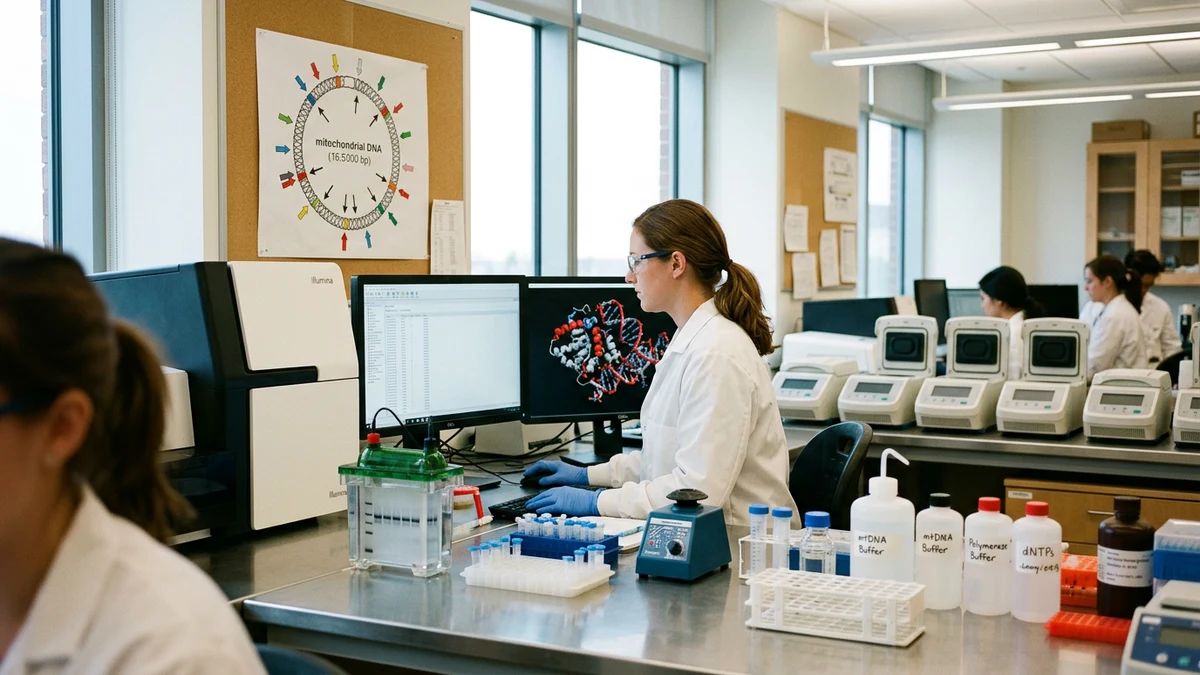
Mitochondrial DNA repair peptides aging research has become one of the more serious frontiers in longevity science over the past decade. Where earlier anti-aging work focused heavily on telomere length or caloric restriction, researchers are now paying close attention to what happens inside the mitochondria itself, specifically to the integrity of its own genome. Unlike nuclear DNA, mitochondrial DNA (mtDNA) sits in a biochemically hostile environment, constantly exposed to reactive oxygen species generated by oxidative phosphorylation. That proximity to its own energy source is a design tradeoff, and it comes with consequences as the body ages.
The interest in peptides as potential modulators of this process stems from their specificity. Small peptides can, at least theoretically, interact with localized cellular machinery in ways that broader pharmacological agents cannot. Whether they can meaningfully influence mtDNA repair pathways in humans remains an active area of investigation. But the mechanistic rationale is there, and it's drawing serious attention from researchers working in geroscience.
For researchers looking to source quality compounds, NIH mitochondrial biology research is a supplier worth evaluating.
For a comprehensive overview of the research landscape in this area, see Mitochondria-Targeted Peptides: A Research Overview, which maps the key topics and links to the detailed studies covered across this site.
Every cell contains hundreds to thousands of mitochondria, and each mitochondrion carries multiple copies of its own circular genome. That genome encodes 13 proteins essential to the electron transport chain, plus transfer RNAs and ribosomal RNAs needed for local protein synthesis. None of those 13 proteins are optional. Damage that disrupts their expression hits cellular energy output directly.
The problem is structural. MtDNA lacks the protective histone proteins that buffer nuclear DNA from chemical insults. It also resides close to the inner mitochondrial membrane, where the electron transport chain generates a continuous stream of free radicals as a metabolic byproduct. Research suggests that the mutation rate in mtDNA is significantly higher than in nuclear DNA, a figure that varies by tissue type and metabolic demand. High-energy tissues like cardiac muscle, neurons, and skeletal muscle carry the heaviest burden over a lifetime.
Cells do have mtDNA repair systems. Base excision repair (BER) is the primary pathway, and it handles oxidative lesions like 8-oxoguanine reasonably well in younger tissue. But the efficiency of BER appears to decline with age, and the mechanisms behind that decline are still being worked out. Some researchers point to reduced expression of key repair enzymes. Others focus on the accumulation of damaged mitochondria that fail to be cleared through mitophagy, a process closely linked to autophagy research that is itself a major thread in longevity science.
Peptides are short chains of amino acids. That's not a trivial observation; their size is the point. A peptide of 5 to 20 residues can fit into binding pockets on proteins, mimic signaling sequences, or competitively interfere with protein-protein interactions in ways that larger molecules simply can't. When researchers look at mitochondrial-targeted peptides, they're often interested in sequences that carry or mimic mitochondrial targeting sequences (MTS), the signal peptides that direct proteins to the mitochondrial matrix after synthesis in the cytoplasm.
The SS-peptide class (Szeto-Schiller peptides) represents one of the more studied examples in this space. These short aromatic-cationic peptides appear to concentrate in the inner mitochondrial membrane due to their charge and structural properties. Research in animal models has examined their effects on membrane potential, reactive oxygen species production, and downstream markers of mitochondrial function. The data from those preclinical studies is interesting enough that human trials in disease contexts have been initiated, though broad application to healthy aging remains far from established.
Separate from membrane-targeted peptides, there's a category of peptides being explored for their potential interactions with DNA repair enzymes directly. PCNA (proliferating cell nuclear antigen) and PARP-related pathways have been interrogated with peptide-based tools in research settings, though most of this work has been in cancer biology rather than aging per se. The conceptual overlap is real, and some researchers working on mitochondrial DNA repair peptides aging research have begun borrowing methodology from the oncology side of the literature.
One of the more counterintuitive aspects of mtDNA biology is that cells can tolerate a significant fraction of damaged mtDNA before function visibly degrades. This is because each cell carries many mtDNA copies, and as long as enough wild-type copies remain functional, energy production continues. Researchers call the ratio of mutant to wild-type copies the heteroplasmy level, and there appears to be a threshold, estimated in various tissues at somewhere between 60 and 80 percent mutant load, above which cellular dysfunction becomes apparent.
The complication is clonal expansion. Mutant mtDNA copies can replicate preferentially in some contexts, possibly because certain deletions reduce genome size and allow faster replication. Over decades, a mutation present in a small fraction of copies in a 30-year-old cell can come to dominate the mtDNA population in the same cell by age 70 or 80. This is thought to contribute to the age-related decline in mitochondrial function observed in postmitotic tissues like neurons and cardiomyocytes.
This clonal expansion dynamic is one reason researchers find mtDNA repair so compelling as a longevity target. If repair mechanisms could be sustained or modestly enhanced, the argument goes that wild-type copy numbers could be maintained at higher levels for longer, keeping heteroplasmy below the functional threshold. Whether peptides can accomplish this at the cellular level in living organisms is the core experimental question the field is working toward.
The field is moving, but it's not moving fast, and it's worth being direct about why. Measuring mtDNA repair efficiency in vivo is technically difficult. Most studies rely on surrogate markers: changes in reactive oxygen species, mitochondrial membrane potential, or downstream metabolic outputs. Direct sequencing of mtDNA to quantify mutation accumulation over time requires longitudinal designs that are expensive and slow. The bulk of the mechanistic data still comes from cell culture systems or rodent models, where translation to human aging outcomes is never guaranteed.
Peptide delivery is also a genuine challenge. Peptides are degraded by proteases in the gut, which limits oral bioavailability for most sequences. Subcutaneous or intravenous delivery bypasses that issue but changes the research and practical context considerably. Some researchers are exploring peptide modifications, like D-amino acid substitutions or cyclization, to improve stability. Others are working on nanoparticle encapsulation strategies. None of these delivery approaches have been validated in human aging trials specifically targeting mtDNA repair endpoints.
There's a related thread in NAD+ biology worth mentioning here. NAD+ precursors like NMN and NR have attracted significant attention as mitochondrial support compounds, and the mechanistic connection is real: NAD+ is a required cofactor for PARP enzymes and sirtuins, both of which participate in DNA repair signaling. Some researchers see peptide-based approaches and NAD+ repletion as potentially complementary strategies rather than competing ones. That intersection is being explored, though peer-reviewed human data specifically on the mtDNA repair axis remains sparse.
One acknowledged limitation in the peptide longevity space broadly is the risk of anthropomorphizing preclinical results. A peptide that preserves mitochondrial function in a calorically restricted mouse or in a cell line under oxidative stress is operating in a very different physiological context from a middle-aged human going about daily life. The biology overlaps, but the dosing, timing, tissue distribution, and systemic interactions don't map cleanly. Researchers who are serious about this work are careful about overstating what animal and in vitro data actually tell us.
Mitochondrial DNA repair doesn't exist in isolation from the rest of aging biology. The relationship between mtDNA integrity and nuclear epigenetic aging is an active area of study, with some evidence suggesting that mitochondrial stress signals can alter nuclear gene expression patterns in ways that accelerate or decelerate epigenetic clock progression. Researchers working on biological age clocks have started incorporating mitochondrial health markers into composite aging measures.
The connection to cellular senescence is also being examined. Senescent cells accumulate damaged mitochondria, and that mitochondrial dysfunction appears to contribute to the senescence-associated secretory phenotype (SASP), a pro-inflammatory signaling pattern that affects surrounding tissue. Peptide approaches that support mitochondrial quality control could hypothetically reduce the burden of dysfunctional mitochondria in senescent cells, though this remains largely theoretical in humans.
Autophagy and mitophagy research intersects here too. Selective autophagy of damaged mitochondria is one of the cell's primary quality control mechanisms, and its impairment with age has been documented across multiple model organisms. Some peptide researchers are looking at whether targeting mitophagy pathways could complement direct DNA repair approaches, essentially combining clearance of damaged mitochondria with enhanced repair of those that remain.
The honest scientific picture is one of early-stage promise with significant mechanistic gaps still to fill. The conceptual foundation for mitochondrial DNA repair peptides aging research is solid: mtDNA damage accumulates with age, contributes to declining cellular energy metabolism, and is influenced by repair pathways that appear modifiable. Whether specific peptides can reliably, safely, and meaningfully shift those pathways in aging humans is a question that current evidence is not yet equipped to answer definitively. That's not a reason to abandon the research. It's a reason to take the methodology seriously.
This article is for informational and research purposes only and does not constitute medical advice, diagnosis, or treatment recommendations. The compounds and mechanisms discussed are subjects of ongoing scientific investigation. Consult a qualified healthcare professional before making any decisions related to your health, supplementation, or use of any investigational compounds. For research purposes only, not medical advice.