The intersection of klotho peptide mitochondrial aging research has become one of the more compelling areas in longevity science over the past decade. Klotho, originally identified as an anti-aging gene in mice, encodes a protein that circulates in the bloodstream and appears to influence a wide range of biological processes, from kidney function to cognitive health. What makes the klotho story particularly interesting to researchers is how it connects to mitochondrial biology, the same cellular machinery that underlies much of what scientists study in areas like NAD+ precursor metabolism and cellular senescence. The protein doesn't operate in isolation, and that complexity is both its scientific appeal and its research challenge.
Klotho exists in two primary forms: membrane-bound and soluble (secreted). The soluble form circulates in the blood and has been the focus of most aging-related research because it can act at a distance from its source tissues, primarily the kidney and brain. Circulating klotho levels tend to decline with age in both animal models and humans, and this decline has been associated, at least correlatively, with markers of accelerated aging. Whether the decline is a cause or a consequence of aging biology is still being sorted out, which is an honest limitation the field continues to grapple with.
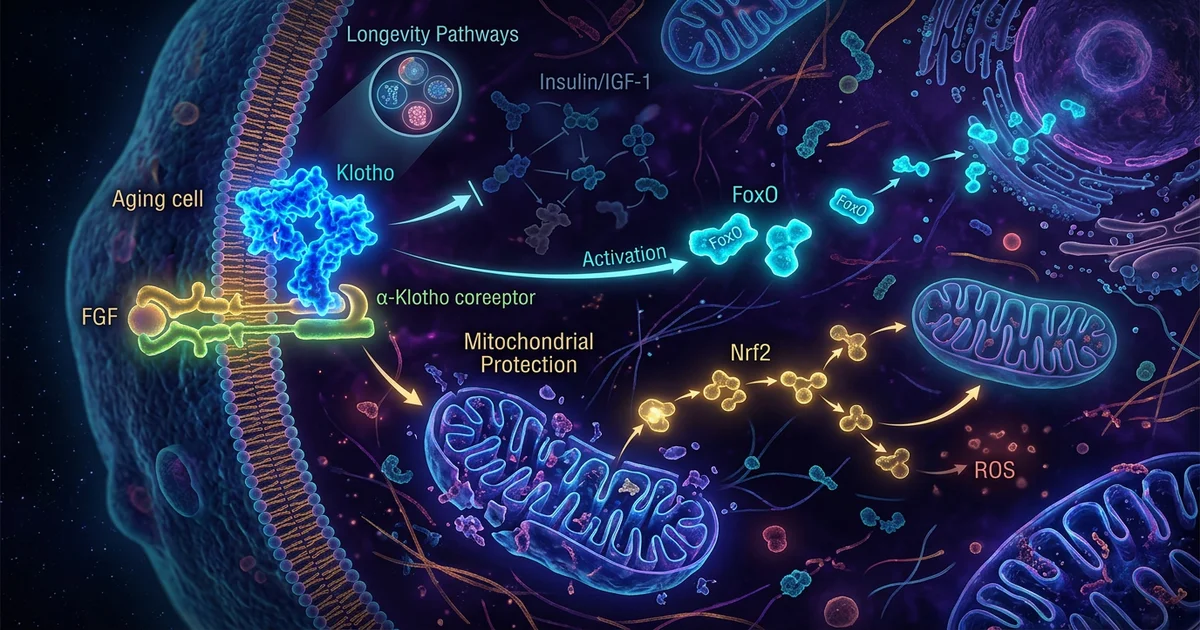
Klotho's molecular behavior is genuinely complex. It functions partly as a co-receptor for fibroblast growth factor 23 (FGF23), helping regulate phosphate and vitamin D metabolism. But the aspects that interest mitochondrial researchers are somewhat separate from that signaling axis. Research suggests that klotho influences oxidative stress pathways, specifically by modulating the activity of superoxide dismutase and other antioxidant enzymes. Oxidative stress is one of the central drivers of mitochondrial dysfunction, so any protein that influences that balance becomes relevant to aging biology quickly.
For a comprehensive overview of the research landscape in this area, see Mitochondria-Targeted Peptides: A Research Overview, which maps the key topics and links to the detailed studies covered across this site.
There's also evidence from animal studies that klotho affects the PI3K/AKT/mTOR signaling pathway, which sits upstream of mitochondrial biogenesis and cellular energy regulation. Reducing mTOR activity has been associated with longevity across multiple model organisms, and klotho appears to act as a partial brake on insulin-IGF-1 signaling in a way that parallels some of those effects. This connects klotho research to broader conversations about caloric restriction mimetics and metabolic aging, two areas with their own growing bodies of investigation.
Researchers have observed in preclinical models that klotho-deficient animals develop what looks like accelerated aging: muscle wasting, cognitive decline, vascular calcification, and shortened lifespan. Klotho-overexpressing mice, by contrast, show extended lifespan in some studies. These aren't subtle findings, which is part of why klotho attracted sustained scientific attention after the original 1997 discovery by Kuro-o and colleagues.
Mitochondria don't just produce ATP. They regulate apoptosis, control calcium buffering, generate reactive oxygen species (ROS) as signaling molecules, and participate in cellular quality control processes like mitophagy. As organisms age, mitochondrial function tends to decline across multiple dimensions: membrane potential drops, electron transport chain efficiency decreases, and the mitochondrial genome accumulates damage more rapidly than the nuclear genome because it lacks substantial repair mechanisms and sits physically close to the ROS-generating machinery.
This is where the klotho-mitochondria connection becomes mechanistically interesting. Some research suggests that klotho helps maintain mitochondrial membrane integrity by reducing excessive oxidative stress at the membrane level. Others have looked at klotho's potential role in regulating mitophagy, the selective recycling of damaged mitochondria, a process that's closely related to research on autophagy-promoting interventions like spermidine and fasting protocols.
One acknowledged complexity here is that most of the supporting mechanistic data comes from cell culture or rodent studies. Translating these findings to humans is not straightforward, and the field doesn't yet have strong clinical trial data on klotho supplementation or klotho peptide administration in healthy aging populations. Practitioners who follow this research closely tend to treat it as directionally promising while acknowledging the gap between mouse models and human physiology is real.
When researchers and practitioners refer to "klotho peptides," they're typically discussing synthetic or recombinant fragments of the full klotho protein designed to preserve some of its biological activity in a more deliverable form. Full-length klotho is a large protein, which creates challenges for bioavailability and stability. Peptide fragments that retain key functional domains are being studied in part because they may be more tractable for research applications.
The KL1 and KL2 domains of the klotho protein have each received research attention. KL1 contains regions associated with the protein's glycosidase-like activity, while KL2 has been studied in relation to FGF receptor binding. Some researchers have focused on shorter derived sequences to examine whether specific biological signals can be replicated without the complexity of the entire protein. This mirrors strategies used in other peptide research areas, like fragment-based analogs studied in tissue repair or metabolic contexts.
It's worth being precise here: the research on klotho peptide fragments is early-stage. Most published work involves in vitro or animal models, and the pharmacokinetics of these fragments in humans haven't been characterized at a clinical level. That's not a dismissal of the research direction, it's just an accurate description of where the science currently stands.
One of the more striking findings in klotho research involves the brain. A 2023 study published in Nature Aging by Dubal and colleagues reported that a specific genetic variant associated with higher klotho levels (the KL-VS heterozygous variant) correlated with enhanced cognitive resilience even in the presence of Alzheimer's-related pathology. The researchers also demonstrated that a klotho fragment improved cognitive function in aged mice and in a primate model. These are headline-worthy findings, though they come with the standard caveat that primate data, while closer to human biology than rodent data, still doesn't confirm human efficacy.
The brain connection matters for mitochondrial aging research because neurons are among the most metabolically demanding cells in the body and among the least replaceable. Neuronal mitochondrial health is directly tied to synaptic function, and cognitive decline in aging correlates strongly with markers of mitochondrial dysfunction in neural tissue. If klotho influences mitochondrial quality control pathways in neurons, that would offer a mechanistic explanation for the cognitive associations observed in human genetic studies.
This also connects klotho research to investigations into other neuroprotective compounds, including peptides that influence brain-derived neurotrophic factor (BDNF) signaling, which is another active area in cognitive aging science.
One aspect of klotho biology that gets less attention in supplement-focused discussions is how lifestyle factors influence endogenous klotho levels. Research suggests that aerobic exercise, particularly moderate-intensity sustained activity, is associated with higher circulating klotho levels. The mechanisms proposed include reductions in inflammatory cytokines that suppress klotho expression and direct effects of exercise on kidney tubular cells, which are a primary source of circulating klotho.
This matters for a practical reason. Any strategy aimed at supporting healthy mitochondrial aging can't ignore the foundational role of physical activity. Exercise independently promotes mitochondrial biogenesis through PGC-1α activation, improves mitochondrial quality control, and reduces systemic inflammation. If it also supports klotho levels, that's an overlapping mechanism worth taking seriously.
Resistance training has a slightly more complicated relationship with klotho in the literature, with some studies showing increases and others showing no change. The data is inconsistent enough that no strong conclusions can be drawn yet. Practitioners who use an evidence-informed approach to longevity protocols tend to recommend combined aerobic and resistance training on exactly the grounds that the mitochondrial and musculoskeletal benefits are well-documented, regardless of what any single biomarker does in response.
Chronic kidney disease is a notable context in all of this because the kidneys are the primary source of circulating klotho, and kidney function is often the first place researchers look when studying klotho deficiencies. This creates a bidirectional research question: does declining klotho accelerate age-related organ damage, or does organ damage reduce klotho production? The honest answer from the current literature is probably both, operating in a feedback relationship that's difficult to untangle in observational studies.
What the klotho and mitochondrial aging field offers right now is a coherent mechanistic hypothesis: that a protein whose circulating levels decline with age plays a role in maintaining mitochondrial quality and oxidative stress balance, and that restoring or supporting those levels through genetic, pharmacological, or lifestyle means might influence the pace of cellular aging. That hypothesis is well-supported enough to justify continued investigation, specific enough to generate testable predictions, and honest enough in its current limitations to be scientifically credible rather than speculative hype.
Ongoing research continues to map the dose-response relationships of klotho-derived peptides across different tissue types, with renal and cardiac models yielding the most reproducible pre-clinical data to date. Whether those findings translate into viable peptide research tools remains an open and actively studied question.
This article is for informational and research purposes only and does not constitute medical advice. Klotho peptides and related compounds discussed here are subjects of ongoing scientific investigation and are not approved treatments for any condition. Individuals should consult a qualified healthcare professional before making any decisions related to supplementation, peptide use, or changes to health protocols. For research purposes only, not medical advice.