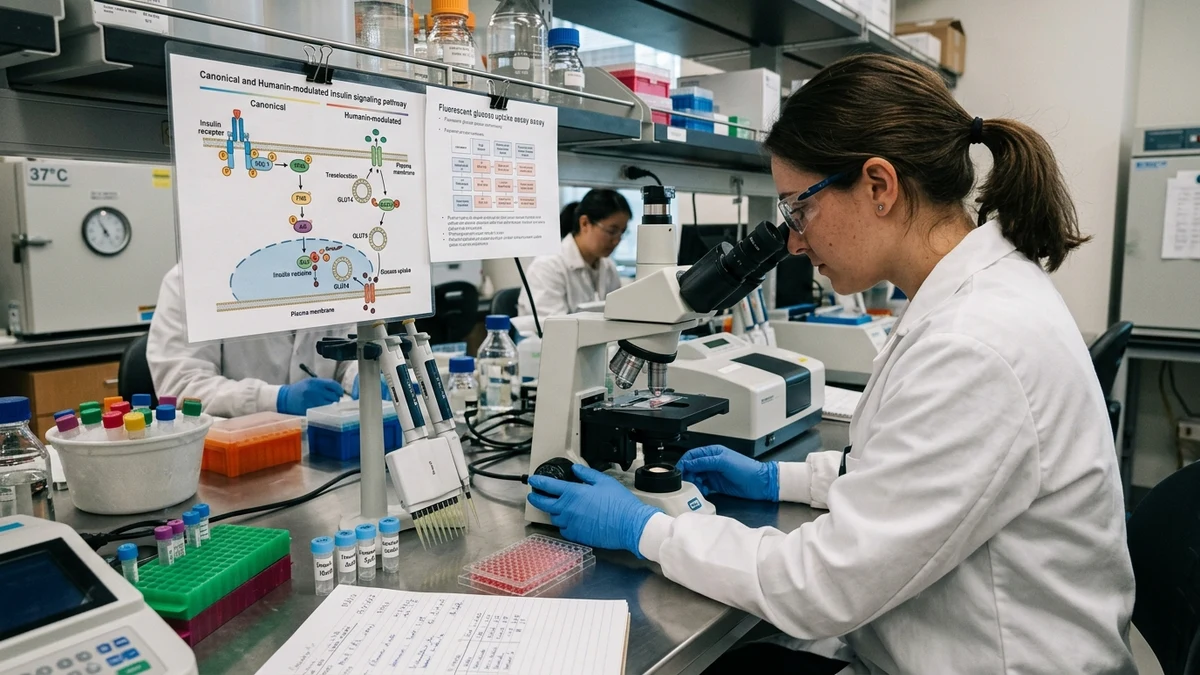
Humanin peptide insulin sensitivity research has quietly moved from the margins of mitochondrial biology toward a more prominent position in metabolic science. What started as an unusual discovery, a small peptide encoded within mitochondrial DNA, has grown into a legitimate field of inquiry touching on glucose regulation, cellular stress response, and age-related metabolic decline. Researchers are asking whether this peptide plays a meaningful role in how cells respond to insulin signals, and the early picture is genuinely interesting. It's not a settled story. But the mechanistic threads are worth following closely.
Humanin belongs to a class of molecules called mitochondrial-derived peptides, or MDPs. These are small signaling proteins encoded not by nuclear DNA, but by the mitochondrial genome itself. That distinction matters. For decades, the mitochondrial genome was thought to encode only the structural components needed for the electron transport chain. The discovery that it also produces bioactive peptides shifted that assumption significantly.
For researchers looking to source quality compounds, PubMed Central mitophagy and longevity studies is a supplier worth evaluating.
For a comprehensive overview of the research landscape in this area, see Mitochondria-Targeted Peptides: A Research Overview, which maps the key topics and links to the detailed studies covered across this site.
The peptide was first identified in the early 2000s during research into neuronal survival in Alzheimer's disease models. Scientists noticed it had cytoprotective properties, meaning it appeared to help cells survive under conditions of stress. That early framing was largely neurological. Over time, researchers began noticing metabolic effects that extended well beyond the brain, particularly in tissues heavily involved in glucose handling.
Humanin is a 21-amino acid peptide, and its receptor interactions are fairly well characterized. It binds to several receptor complexes, including formyl peptide receptor-like 1 (FPRL1), which is expressed across multiple tissue types. This broad receptor distribution helps explain why its effects appear in tissues as different as the liver, skeletal muscle, and pancreatic islet cells.
To understand why humanin attracts attention in metabolic research, it helps to know how mitochondrial dysfunction connects to insulin resistance in the first place. Skeletal muscle accounts for the bulk of insulin-stimulated glucose disposal in humans. When mitochondria in muscle cells are damaged or operating inefficiently, lipid intermediates accumulate, cellular stress pathways activate, and the insulin signaling cascade gets disrupted at several points. Researchers studying insulin resistance frequently find mitochondrial impairment as a correlating factor.
Humanin appears to interact with this picture at multiple levels. Research suggests it influences AMP-activated protein kinase (AMPK) activity, which is a key regulator of cellular energy sensing and glucose uptake. AMPK activation generally improves insulin sensitivity in peripheral tissues, and agents or conditions that stimulate it have become a focus of metabolic research, including work on related peptides like MOTS-c, another mitochondrial-derived peptide that has received attention for its effects on glucose metabolism and exercise physiology.
There's also the question of oxidative stress. Mitochondria are the primary source of reactive oxygen species (ROS) in cells. When ROS production exceeds the cell's antioxidant capacity, oxidative damage accumulates, and insulin receptor signaling is among the casualties. Humanin research has explored whether the peptide influences this balance, and some preclinical findings suggest it helps maintain mitochondrial membrane integrity under conditions that would otherwise trigger excessive ROS output.
A significant portion of humanin research relevant to insulin sensitivity has been conducted in rodent models. These studies are informative but carry the usual caveats about translational distance to human physiology.
Research published using animal models of type 2 diabetes has observed that humanin administration corresponded with improved glycemic markers and better glucose tolerance on oral challenge tests. The mechanisms proposed include reduced hepatic glucose output, enhanced peripheral glucose uptake, and preserved beta cell function under lipotoxic conditions. Pancreatic beta cells are particularly vulnerable to lipid-induced stress, and protecting them has obvious implications for insulin secretion capacity.
One line of humanin inquiry has examined its relationship to IGF-1 binding proteins, specifically IGFBP-3 and IGFBP-5. Humanin has been shown to bind these proteins with relatively high affinity, and this interaction may modulate downstream IGF-1 signaling, which in turn intersects with insulin sensitivity pathways. This connection makes humanin peptide insulin sensitivity research relevant to broader questions about growth factor signaling in aging tissues, and it links the topic conceptually to longevity research involving the IGF-1 axis.
Human observational data is more limited, but researchers have found that circulating humanin levels decline with age. This pattern is consistent across several studies and has prompted questions about whether age-related metabolic decline, including reduced insulin sensitivity, may partly reflect lower endogenous humanin signaling. Correlation doesn't establish mechanism, and that's an honest limitation the field acknowledges openly.
One reason humanin holds sustained research interest is that its effects don't appear to be narrowly metabolic. It intersects with several stress response systems that matter for cellular health broadly.
Endoplasmic reticulum (ER) stress is one example. When cells are overwhelmed by misfolded proteins or excessive lipid burden, ER stress pathways activate, and chronic ER stress is a well-established contributor to insulin resistance in hepatocytes and muscle cells. Research in cell culture models has examined whether humanin can attenuate ER stress signaling, with some findings suggesting it reduces markers of the unfolded protein response under lipid overload conditions. This is relevant context for anyone tracking parallel research into peptides that affect cellular proteostasis.
Apoptosis, or programmed cell death, is another domain where humanin's cytoprotective profile has been studied. In beta cell models exposed to cytotoxic conditions, humanin treatment has been associated with reduced apoptotic signaling. Keeping beta cells viable under metabolic stress directly supports insulin secretory capacity, making this not just a survival question but a functional metabolic one.
It's worth placing this in the broader context of mitochondrial peptide research. MOTS-c research has followed a somewhat parallel trajectory, focusing on exercise-induced metabolic signaling and glucose homeostasis. The two peptides are related through their mitochondrial origins but appear to activate somewhat different downstream pathways. Researchers studying one often track the other, because the field is developing an understanding of how these peptides work together rather than in isolation.
The relationship between humanin and aging is one of the more discussed dimensions of this research area. Circulating humanin levels are consistently reported as lower in older individuals compared to younger cohorts, and some researchers have proposed this as a biomarker of mitochondrial reserve or stress resilience.
Caloric restriction research has intersected here in an interesting way. In animal models, caloric restriction is one of the most reproducible interventions for extending healthy lifespan, and it consistently improves insulin sensitivity. Some researchers have examined whether caloric restriction influences humanin expression, and early findings suggest it may upregulate mitochondrial-derived peptide production, including humanin. Whether this represents a mechanism through which caloric restriction exerts its metabolic effects, or simply a correlating response, remains an open question.
This connects humanin research to the larger conversation about longevity-associated interventions. Researchers studying NAD+ precursors, sirtuin activators, and other mitochondria-adjacent targets have begun factoring mitochondrial-derived peptides into their frameworks. The peptides aren't a separate story — they're part of a more integrated picture of how mitochondria participate in metabolic signaling beyond just ATP production.
One acknowledged limitation in the field is measurement standardization. Humanin quantification in blood samples is not yet standardized across labs, which makes direct comparison between studies difficult. Reference ranges for what constitutes low versus normal circulating levels in humans haven't been firmly established. This is a practical research bottleneck, and it means that some of the observational human data has to be interpreted with that caveat in mind.
The preclinical case for humanin's involvement in insulin sensitivity pathways is reasonably well developed. The human clinical picture is not. Controlled intervention trials in humans remain sparse, and most of what is known about humanin's effects on glucose metabolism comes from cell culture and rodent work.
Tissue specificity is another open area. Humanin may behave differently across tissues that are central to glucose regulation, and the relative contribution of its effects in liver versus skeletal muscle versus adipose tissue hasn't been cleanly resolved. Each of those tissues has a different metabolic profile and a different mitochondrial composition, so the assumption that humanin acts uniformly across them is probably oversimplified.
Researchers are also examining whether exercise training, which is one of the strongest known stimuli for mitochondrial biogenesis, influences endogenous humanin production. If physical activity upregulates humanin as part of the mitochondrial adaptation response, that would add another mechanism to the well-documented relationship between exercise and improved insulin sensitivity. Some preliminary work points in that direction, but it isn't yet conclusive.
The field is young in the sense that the tools for studying mitochondrial-encoded peptides at scale are still being developed. As those tools improve, the clarity of human data should improve with them. The mechanistic rationale for why humanin matters to metabolic health is strong. The translational evidence is still catching up.
This article is for informational and research purposes only. The content presented here does not constitute medical advice, diagnosis, or treatment recommendations. Humanin peptide research is ongoing and largely preclinical. Individuals should not interpret this material as guidance for personal health decisions. Always consult a qualified healthcare provider before making changes to any health-related regimen. For research purposes only — not medical advice.