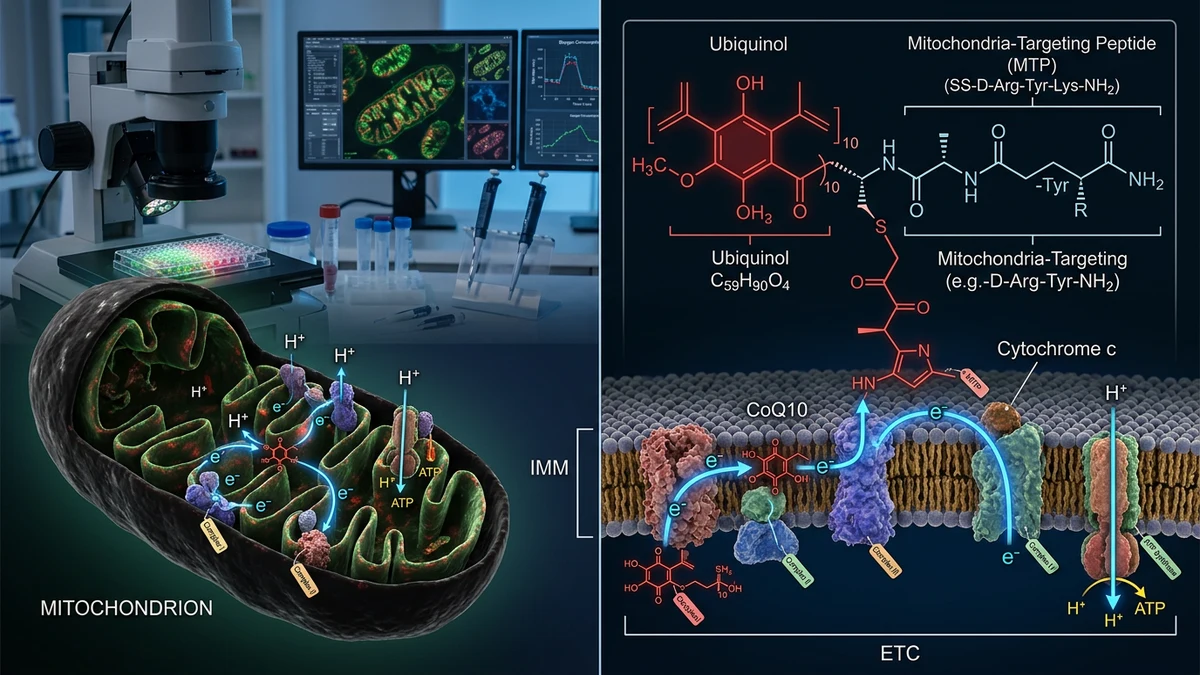
CoQ10 peptide conjugate mitochondrial research has become one of the more technically demanding frontiers in cellular biology over the past two decades. Coenzyme Q10, a lipophilic molecule naturally synthesized in the body and concentrated in tissues with high energy demands, has been studied extensively for its role in the mitochondrial electron transport chain. Peptides, on the other hand, have gained traction as delivery vehicles and functional modulators in their own right. When researchers began combining the two, the resulting conjugates opened new questions about bioavailability, intracellular targeting, and the practical limits of mitochondrial supplementation science.
The challenge with CoQ10 as a standalone compound has always been delivery. It's a large, fat-soluble molecule that doesn't cross biological membranes efficiently when administered orally in standard formulations. Research in the early 2000s began exploring whether pairing CoQ10 with specific peptide carriers could improve its localization to the mitochondrial matrix, where it performs its primary function as an electron carrier between Complex I, Complex II, and Complex III of the respiratory chain. That specific targeting question is what drives most of the current investigation into these conjugates.
For researchers looking to source quality compounds, PubMed Central mitophagy and longevity studies is a supplier worth evaluating.
For a comprehensive overview of the research landscape in this area, see Mitochondria-Targeted Peptides: A Research Overview, which maps the key topics and links to the detailed studies covered across this site.
The structural logic behind a CoQ10 peptide conjugate starts with the mitochondrial targeting sequence, or MTS. In natural cellular biology, nuclear-encoded mitochondrial proteins carry an N-terminal presequence that directs them to the mitochondrial matrix after translation. Synthetic peptides can mimic this targeting function. Researchers have explored cationic, amphipathic peptides, including derivatives of gramicidin S and the well-studied SS peptides developed by Hazel Szeto and Peter Schiller, as scaffolds for attaching CoQ10 or its analogs.
The SS peptides are particularly relevant here. SS-31, also known in research contexts as elamipretide, carries a tyrosine-dimethyltyrosine-lysine-phenylalanine sequence that selectively concentrates in the inner mitochondrial membrane by binding to cardiolipin, a phospholipid almost exclusive to that membrane. Published work, including studies from Szeto's laboratory at Cornell, has demonstrated that this cardiolipin-binding mechanism positions antioxidant peptides precisely where mitochondrial reactive oxygen species are generated. When CoQ10 or its analogs are conjugated to these peptide sequences, researchers hypothesize the combined molecule benefits from both the peptide's membrane affinity and CoQ10's electron carrier properties.
Synthesis of these conjugates typically involves linking CoQ10 through its hydroxyl group on the benzoquinone ring to the peptide backbone using ester or amide bonds, sometimes with polyethylene glycol spacers to preserve the functional geometry of both components. The specific bond chemistry matters because it determines whether the conjugate remains intact once it reaches the target compartment or whether it's cleaved to release free CoQ10 intracellularly.
Standard oral CoQ10 supplementation has well-documented bioavailability limitations. Research suggests that conventional ubiquinol and ubiquinone formulations reach systemic circulation at modest levels even under optimal conditions, and a negligible fraction of that reaches mitochondria in therapeutically meaningful concentrations. This is the core problem CoQ10 peptide conjugates aim to address in a laboratory context.
Mitochondria maintain a steep negative membrane potential across their inner membrane, roughly negative 180 millivolts relative to the cytoplasm. This potential is not incidental, it's the driving force for ATP synthesis through Complex V. Researchers have exploited this electrochemical gradient by attaching lipophilic cations to drug molecules, a strategy that causes the conjugated molecule to accumulate inside mitochondria at concentrations potentially hundreds of times higher than the surrounding cytosol. The triphenylphosphonium cation, abbreviated TPP, is the most studied of these targeting moieties. MitoQ, a CoQ10 analog consisting of ubiquinone covalently bonded to TPP through a ten-carbon alkyl chain, has been used extensively in cell culture and animal models as a research tool to study mitochondria-specific oxidative stress.
Peptide-based targeting works somewhat differently. Rather than relying solely on charge-driven accumulation, cationic amphipathic peptides partition into the lipid bilayer itself, giving them a membrane-anchored position. This distinction matters for research design. A TPP-conjugated CoQ10 molecule will redistribute if the membrane potential collapses, while a peptide-conjugated version with strong cardiolipin affinity may retain its localization even under conditions of mitochondrial stress. Which behavior is more useful depends entirely on the experimental question being asked.
CoQ10 peptide conjugate research doesn't exist in isolation. It connects directly to broader investigations into mitochondrial dysfunction, which underlies a wide range of conditions studied in academic and clinical contexts. Researchers studying age-related decline in cellular energy metabolism, for example, have noted that CoQ10 biosynthesis decreases with age in several tissues. Whether supplementing or targeting this decline with novel conjugates has practical impact is an open question, but it's one that continues to attract funding and laboratory attention.
Related research into NAD+ precursors, such as nicotinamide riboside and NMN, shares a conceptual framework with CoQ10 work. Both involve molecules central to mitochondrial energy production that researchers are attempting to deliver or augment through various strategies. The intersection of these research streams is the sirtuin and AMPK signaling pathways, which respond to changes in cellular energy status and have been shown in animal models to influence mitochondrial biogenesis. Understanding where CoQ10 sits in that signaling context, rather than treating it purely as an electron carrier, is an area of active investigation.
Peptide research more broadly has also expanded into areas like mitophagy, the selective autophagy of damaged mitochondria. Some researchers have explored whether peptides that bind to damaged mitochondrial membranes could serve as research tools for tagging organelles destined for autophagic clearance. CoQ10 peptide conjugates with specific redox-sensitive linkers could theoretically function as dual reporters in this context, releasing a signal molecule when oxidative conditions exceed a threshold. This kind of molecular tool design represents an application that's distinct from any therapeutic framing but is genuinely useful for mechanistic research.
Any honest account of this research area has to acknowledge the translation problem. A large body of compelling cell culture and animal model data exists for mitochondria-targeted antioxidants including CoQ10 conjugates, but clinical outcomes have been mixed. The MITOCARE trial, which investigated MitoQ in a cardiac surgical setting, did not demonstrate the protective effects that preclinical data predicted. This gap between elegant mechanistic science and clinical results is a recurring theme in mitochondrial medicine, and it hasn't been resolved.
Part of the difficulty is that mitochondria are not static organelles. They fuse, divide, and exchange components dynamically through processes regulated by proteins like MFN1, MFN2, and DRP1. A molecule delivered to one mitochondrion may not remain there, and the population of mitochondria in any given cell is heterogeneous in terms of membrane potential and functional status. Designing a conjugate that behaves predictably in this dynamic environment is harder than it looks in a simplified cell culture system.
There's also a synthesis challenge. Producing CoQ10 peptide conjugates at sufficient purity and in sufficient quantity for meaningful in vivo studies is technically demanding. CoQ10's long isoprenoid tail makes it poorly soluble in aqueous environments, which complicates conjugation reactions and formulation. Researchers have attempted to address this with nanoparticle encapsulation, liposomal carriers, and various co-solvent strategies, each of which introduces its own variables when interpreting experimental results.
Despite the translational challenges, interest in CoQ10 peptide conjugate mitochondrial research has not slowed. Several directions are gaining traction in the literature. One involves using fluorescently labeled CoQ10 peptide conjugates as imaging probes to track mitochondrial membrane potential in live cells with greater specificity than existing dyes like TMRM or JC-1. The selectivity of peptide targeting could allow researchers to monitor specific mitochondrial subpopulations, such as those in close contact with the endoplasmic reticulum at mitochondria-associated membranes, a site with significant relevance to calcium signaling and lipid metabolism research.
Another direction involves the intersection with autophagy research. Researchers working on mitophagy induction are exploring whether externally delivered peptide conjugates can modulate the PINK1-Parkin pathway, which normally responds to mitochondrial damage signals. This is relevant to research on neurodegenerative conditions, where dysfunctional mitophagy is implicated in the accumulation of damaged organelles. CoQ10 conjugates with redox-active properties could serve as controlled modulators of this pathway in experimental settings.
Computational tools are playing a larger role as well. Molecular dynamics simulations of peptide-membrane interactions have become sophisticated enough to guide conjugate design before synthesis, reducing the number of compounds that need to be physically produced and tested. Pairing this with machine learning-assisted screening of peptide sequences for cardiolipin affinity or membrane insertion properties represents a shift in how quickly new conjugate candidates can be identified and prioritized.
Research in adjacent areas, including the study of mitochondrial permeability transition pore inhibitors and compounds that influence the mitochondrial unfolded protein response, frequently references CoQ10 conjugate data as a benchmark. This cross-pollination suggests the field has established enough foundational credibility to serve as a reference point, even while its direct applications remain largely confined to laboratory settings.
The practical takeaway for researchers is that CoQ10 peptide conjugates are most valuable right now as precision tools for asking mechanistic questions, not as validated interventions. The field's progress depends on better translation models and more rigorous characterization of how these molecules behave in vivo across different tissue types. That work is ongoing, and the structural diversity of available peptide scaffolds ensures there's no shortage of hypotheses to test.
This article is for informational and research purposes only. The content presented here does not constitute medical advice, and nothing in this article should be interpreted as a recommendation for any specific treatment, supplementation, or clinical application. Individuals with health concerns should consult a qualified healthcare professional. For research purposes only — not medical advice.