ATP synthase peptide modulators research sits at one of the more compelling intersections in modern bioenergetics: the study of small peptide sequences that may influence the behavior of ATP synthase, the molecular machine responsible for producing adenosine triphosphate in mitochondria. For anyone tracking developments in cellular energy metabolism, this area has attracted serious scientific attention over the past decade, and the questions being asked are getting sharper. What happens when peptide molecules interact with the rotary complex of ATP synthase? Can targeted modulation of this enzyme affect downstream energy availability in measurable ways? The research isn't settled, but the mechanistic framework is becoming clearer.
This article is for informational and research purposes only. None of the content below constitutes medical advice, and nothing described here should be interpreted as a recommendation to use any compound, peptide, or supplement. Consult a qualified healthcare professional before making any changes to health, training, or supplementation protocols. For research purposes only — not medical advice.
For researchers looking to source quality compounds, PubMed Central mitophagy and longevity studies is a supplier worth evaluating.
For a comprehensive overview of the research landscape in this area, see Mitochondria-Targeted Peptides: A Research Overview, which maps the key topics and links to the detailed studies covered across this site.
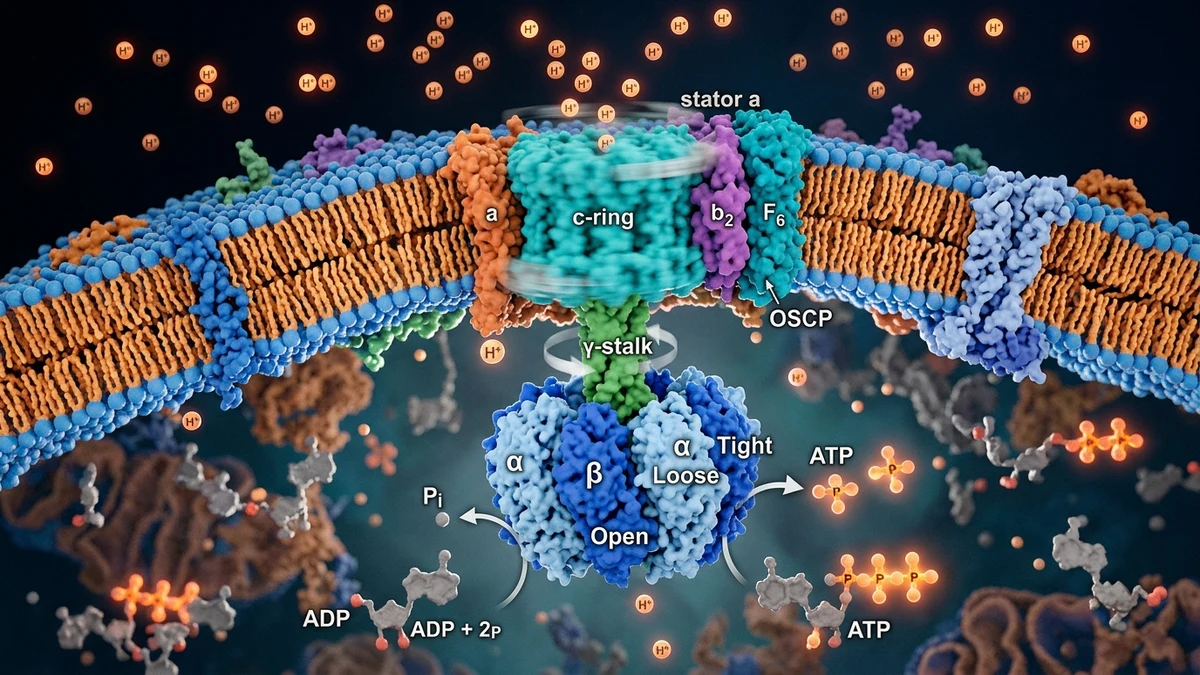
To understand why peptide modulation of this enzyme matters, it helps to appreciate just how central ATP synthase is to biological energy production. The enzyme, formally known as F-type ATP synthase or Complex V, operates through a remarkable rotary mechanism embedded in the inner mitochondrial membrane. Protons flow down an electrochemical gradient through the F0 subunit, driving rotation of a central stalk that physically forces conformational changes in the F1 catalytic domain — and those conformational changes drive the phosphorylation of ADP into ATP.
A resting adult human synthesizes and consumes roughly their body weight in ATP each day, a figure that speaks to how relentless this enzyme's workload really is. Exercise, metabolic stress, and caloric restriction all change the demand placed on this system, which is part of why researchers interested in performance physiology and metabolic health have looked toward ATP synthase as a meaningful target.
The enzyme's modular structure also makes it a plausible target for peptide interaction. Unlike many single-domain proteins, ATP synthase presents multiple subunit interfaces, regulatory sites, and membrane-proximal regions where small molecules, including peptides, could theoretically bind and alter function. This structural complexity is precisely what makes the research both promising and difficult to interpret cleanly.
Peptides, as short chains of amino acids, occupy an interesting pharmacological space. They're large enough to interact with protein surfaces with some specificity, but small enough to be synthesized and studied at reasonable cost. In the context of ATP synthase research, "modulators" is a deliberately broad term. Some peptides studied in this area appear to inhibit ATP hydrolysis, others seem to affect subunit assembly, and still others are being examined for their influence on the mitochondrial membrane potential that drives the proton gradient in the first place.
Research methodologies in this space typically involve a combination of in vitro enzyme assays, cell culture studies, and, in more advanced work, animal models. Binding affinity is often characterized using techniques like surface plasmon resonance or isothermal titration calorimetry. Functional outcomes — changes in ATP production rate, oxygen consumption, or membrane potential , are measured through established bioenergetic assays, with instruments like the Seahorse XF analyzer becoming a standard tool in academic lab settings.
It's worth being transparent about a limitation here: much of the most compelling mechanistic data in this field comes from isolated enzyme preparations or cultured cell lines. Translating those findings into predictions about whole-organism physiology is genuinely difficult. Peptide stability in biological fluids, delivery to mitochondria, and off-target binding all complicate the path from in vitro to in vivo relevance. Researchers are actively working on these delivery challenges, but they haven't been fully solved.
Related subjects like mitochondrial-targeted antioxidants and NAD+ precursor research share this same translation problem, which is one reason the broader field of mitochondrial pharmacology tends to advance in incremental steps rather than dramatic leaps.
The F0 subunit has drawn particular interest because it's the site of proton translocation, making it the engine that powers the whole rotary mechanism. The c-ring, a circular arrangement of c-subunits within F0, is one structural element that researchers have focused on. Small peptides or peptide-mimetic compounds that insert into or near the c-ring could, in principle, alter the efficiency of proton coupling, either enhancing it or creating partial decoupling.
The inhibitory factor 1 protein, known as IF1, is another area of intense study. IF1 is an endogenous peptide that binds the F1 catalytic domain and inhibits ATP hydrolysis under conditions of low mitochondrial membrane potential. Research suggests that synthetic peptides modeled on the IF1 binding interface can replicate some of this inhibitory activity in cell-free systems. The physiological significance of that observation is still being worked out.
The OSCP subunit, which connects the peripheral stalk of the enzyme to the F1 head, has emerged as a regulatory hub. Studies published in peer-reviewed journals over the past several years have described OSCP interactions with several endogenous peptides and small molecules, some of which appear to affect mitochondrial permeability transition. This connects ATP synthase research to broader questions about cell survival signaling and mitochondrial quality control, subjects that also intersect with research into senolytics and mitochondrial biogenesis peptides.
Sports science and metabolic health research have a natural stake in understanding ATP synthase modulation. Skeletal muscle is among the most metabolically active tissues in the body, and its performance depends directly on mitochondrial capacity. Research suggests that endurance training increases the density and efficiency of mitochondrial complexes, including Complex V, in muscle tissue. The question researchers are now exploring is whether exogenous peptide modulation could augment or complement those adaptations.
This isn't speculative in the abstract. Preclinical studies have examined whether compounds influencing mitochondrial coupling efficiency affect exercise capacity in animal models. The findings are mixed and highly dependent on the specific compound, dose, and animal model used. Some work suggests that partial uncoupling, somewhat paradoxically, can improve metabolic flexibility in certain contexts. Other lines of research focus on preserving ATP synthase function during states of metabolic stress, such as ischemia-reperfusion in cardiac tissue.
The connection to caloric restriction research is also worth naming. Caloric restriction reliably extends healthspan in multiple model organisms, and part of its effect appears to involve changes in mitochondrial function, including shifts in ATP synthase activity and efficiency. Whether peptide modulators could selectively recapitulate these effects without full caloric restriction is a genuine research question being explored in aging biology labs. It connects naturally to work on AMPK-activating compounds and other metabolic signaling modulators that have gained traction in longevity research circles.
The honest picture of where ATP synthase peptide modulator research stands is one of promising mechanistic insight paired with real uncertainty about clinical or applied relevance. The foundational biochemistry is well-characterized. The enzyme's structure has been resolved at near-atomic resolution thanks to cryo-electron microscopy advances, giving researchers an unusually detailed map of potential interaction sites. That structural clarity has accelerated peptide design efforts considerably.
What lags behind is the functional validation work, particularly in human physiology. Most researchers publishing in this area are careful to frame their findings in terms of mechanistic hypotheses rather than confirmed effects. That's the appropriate scientific posture, but it does create a gap between the technical sophistication of the biochemistry and what can actually be claimed about human outcomes.
There's also the question of specificity. ATP synthase is present in essentially every cell that relies on oxidative phosphorylation. A systemic modulator would need to be either extremely targeted in its delivery or extremely well-tolerated across tissues to avoid disrupting energy metabolism in organs where intervention isn't wanted. Tissue-targeted delivery, including mitochondria-penetrating peptide conjugates, is an active research area specifically because this problem is recognized.
Academic groups in metabolic biochemistry, structural biology, and translational physiology are all contributing to this field from different angles. The convergence of structural data, peptide chemistry tools, and more accessible bioenergetic assay platforms means the pace of discovery has accelerated, even if definitive applied outcomes are still years away.
For practitioners and researchers tracking peptide science more broadly, ATP synthase modulation represents one of the more mechanistically grounded areas of inquiry, distinct from peptides that act primarily through receptor signaling cascades. The enzyme itself is the target, its structure is known, and the questions being asked are specific. That specificity is what keeps this research worth watching.
A broader consideration for researchers in this space involves the structural complexity of the ATP synthase target. The F1Fo complex is not a simple enzyme but a rotary molecular machine with multiple subunits, each representing a potential interaction site. Different peptide modulators may act at distinct subunits with distinct downstream effects, making cross-study comparisons difficult when binding targets are not precisely characterized. Structural biology tools, particularly cryo-electron microscopy, have dramatically improved resolution of ATP synthase structure in recent years, and this is beginning to enable more targeted peptide design. Researchers reviewing older studies in this literature should be aware that some early mechanistic claims were made without this structural clarity and may need reinterpretation in light of improved structural models.
This article is for informational and research purposes only. The content presented does not constitute medical advice, diagnosis, or treatment recommendations. No compounds discussed herein are approved for human use in the contexts described. Always consult a licensed medical professional before considering any peptide, supplement, or experimental compound. For research purposes only , not medical advice.